Wednesday, 22 January 2020

Tuesday, 21 January 2020
Habitat : Cave
Hej! We’re researching the olm (proteus anguinus) which is a little water salamander that lives in the darkest zones of the caves. It can be found along the subterranean streams in the karst areas of Adriatic coast in Europe, specifically in southern Slovenia, Croatia, Italy, France. The olm is a really cool being and is used in scientific research as a model for the evolution of highly specialized sensory adaptations in dark water environments. Probably it could give leads on research towards eternal youth, which is specifically associated with their low metabolic rate and cold environments it thrives in.

It’s quite interesting to investigate on these blind aquatic salamanders, which thrive their entire life in darkness and live up to 70 years on an average which tags it to the longest lived amphibian in the world. Did you know it can survive without food for up to a decade? Wow! Wish we humans could lead such a minimalist lifestyle! We start here, our research to dive into the darkness, to look without sight, without light!
FOREST1 - Boreal Forests and resilience
STEP1: RESEARCH
Reading, analysing, processing about Boreal Forests as systems
How do boreal forests collect, manage water?
How can boreal forests can teach us to make cities resilient to floods?
Boreal forests constitue the Earth's largest carbon reservoir in soil below ground and in the permafrost, equal to the amount above ground in tropical forests. The 16,6 million of km² of boreal forests constitute 15% of the Earth's land surface and 1/3 of the Earth's forest cover, in a circumpolar band throughout the northern hemisphere through Russia, northern Europe, Canada, and Alaska. They countain more surface freshwater than any other biome. They are caracterised by long, cold winters, and short, dry and warm summers ; and are composed by both evergreen and deciduous trees. Wetlands and bogs are common, with soils being laden with peat and permafrost.
According to the IPCC, global waming is felt twice stronger in these forests, leading to a shift in ecosystems. Evergreen trees being sensitive to warm climates, they slowly leave space for more deciduous trees, that are expected to be 15% more present by the end of the century.
Boreal forests are very efficient ecosystems in term of water management, that lead to store great quantities of carbon, and be resilient ecosystems to wildfires, rainfall, floods.
With climate change, many cities will have to deal with greater rainfall and floods.
How can boreal forests teach us to make cities resilient to floods?

Draft poster of the research
Boreal forests work as resilient ecosystems where biodiversity is rich. Different strategies work together to thrive despite the harsh environment.
SEASONAL STRATEGIES
Evergreen and deciduous trees have different strategies. The latter absorb less than 1% of their volume in water in summer, while in winter, they have a higher transpiration and lower absorption by soil. Deciduous trees can absorb up to 25% of water, and have immediate water transpiration after saturation ; while in winter, when leaves fall, they have a low transpiration and high absorption by soil, leaving to a lower year-round transpiration.
These two families participate in rainfall, through transpiration. Less trees would induce a decline in transpiration, and thus a weakening of rainfall.
LAYERS
Boreal forests have a system of layers that work together. For example during periods of rain, canopies intercept up to 70% of the rainwater, which then evaporates directly from them. The precipitation that falls then either infiltrates the gronud, flows on the surface, or evaporates. This works along with the slow metabolism of the whole ecosystem that benefits from limited daylight and thus requires less water and nutrients.
WETLANDS
Different kinds of wetlands, organic wetlands and mineral wetlands, work together, enriching boreal forests. Organic wetlands (bogs and fens), are made of nutrient poor soil covered with at least 40 centimeters of peat, making the decomposition process slow, leading to a slow release of carbon. They are carbon sinks. Mineral wetlands (swamps, marshes, open water) have nutrient rich soils, and are covered by less than 40 centimeters of peat. They act as sponges that absorb water and release it during drought ; and filter, store and transport large amounts of water.
SAFE NETWORK
Trees of the same species work together : they fuse roots to share water and nutrients, also allowing for a free flow of carbon between trees thanks to mycorrhiza fungi that grow between roots. They are saving points in case of catastrophe such as wildfires which destroy the forest above soil. The trees can later grow from these roots and fungi that saved nutrients.
MANAGING ENVIRONMENT
Different species of lichen and moss coexist and work together in boreal forests, however peat moss (sphagnum) is the most present one, along with feather moss. They both constitute 95% of the ground cover. It can hold up to 20 times its dry weight in water, and forms a 50 centimeters thick mat. It grows from broken pieces of bigger plants, doesn't have a developed root system, and doesn't need light. It adapts to its environment by creating its own habitat, acidifying its surroundings.
Feather moss filters waters, regulates the nutrient uptake and minimises nutrient losses.
PEAT MOSS
Peat moss has particular leaves that expands to collect the most water possible instantly. Their rhizoids are also particularly effective to absorb water, the attraction between the rhizoids and the water molecules being stronger than being the water molecules themselves.
All these are part of the global complex system that boreal forests are, and help it thrive in a harsh climate.
What can we learn from boreal forests to make cities more resilient to heavier rainfall and floods in the future?
Group Desert _ Dung Beetle
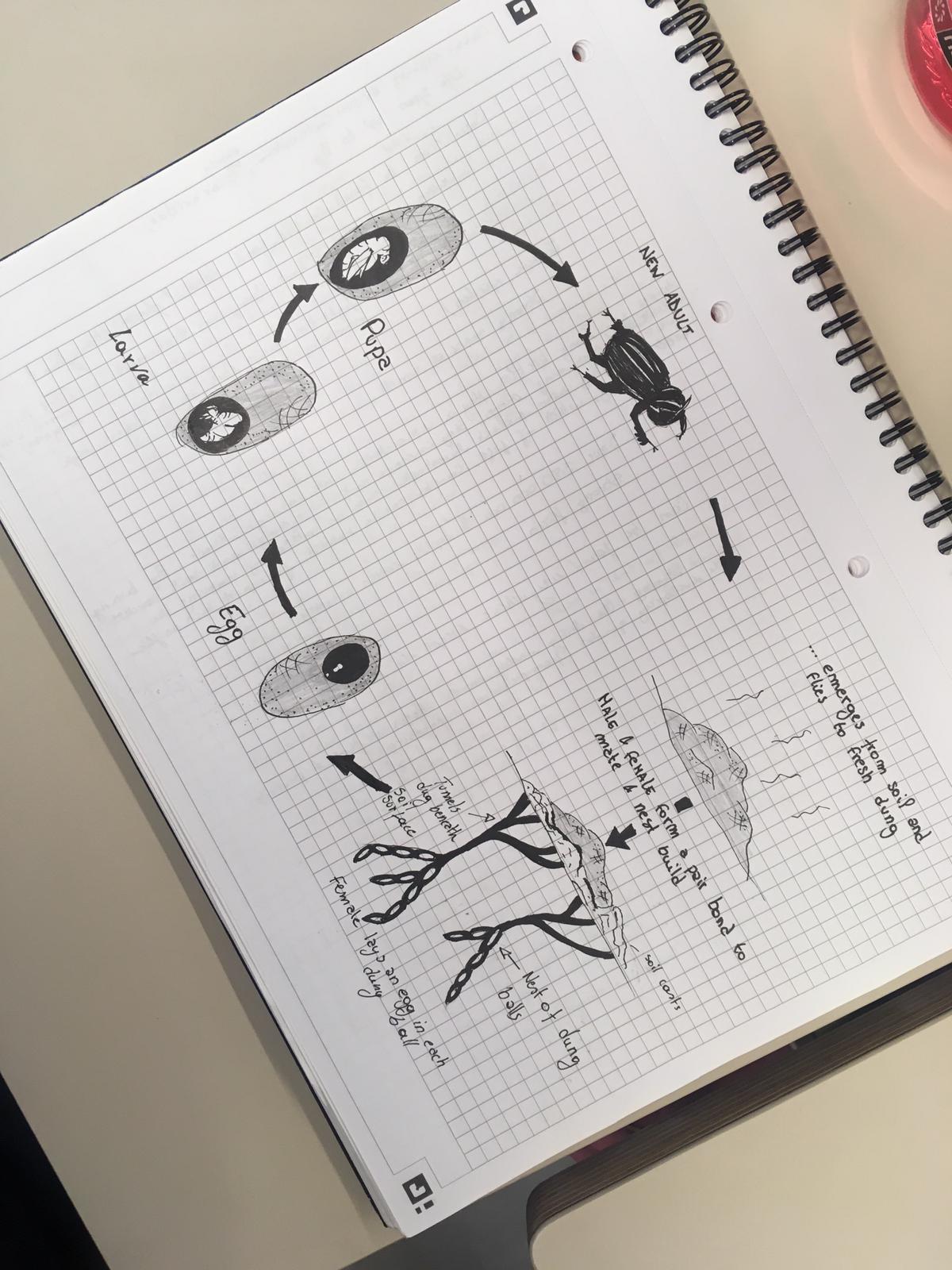
Analyzing the desert, in our case focused on the hot desert, there is an efficient animal learned how to deal with this extreme dry environment by using dung from other animals, the dung beetle.
Dung beetles are an essential part of the ecosystem by proceeding the dung by tunneling, burying, and fragmenting it. This whole process not only quickly and efficiently removes dung from the surface, it brings all those important nutrients back down into the soil, making the soil fertile and our pastures productive.
Dung beetles are an essential part of the ecosystem by proceeding the dung by tunneling, burying, and fragmenting it. This whole process not only quickly and efficiently removes dung from the surface, it brings all those important nutrients back down into the soil, making the soil fertile and our pastures productive.

In its tunnels systems they are also protected from the extreme heat.
To transport the dung with balls the dung beetle is one of the strongest animals in comparison to its own body size. It can lift up 250 times their own weight, they are extreme strong force generator to move their dung bowls.

Marine group focusing on the GIANT TUBE WORM


* Hydrothermal vents are the result of vulcanic activity. Cold seawater enters cracks in the seafloor and is heated by hot magma. The vent is formed when the hot fluids reemerge to the sea.
Friday, 8 February 2019


Wednesday, 6 February 2019

Subscribe to:
Posts (Atom)